Image Data Pop-Up Menu
A pop-up menu is available in the Data Settings and Properties to provide access to dataset tools for cropping, sampling, and converting image data, as well as functions such as image stitching, dataset registration, and image stack alignment.
 Items Available for a Single Selection
Crop
Items Available for a Single Selection
Crop
Opens the Dataset Cropper panel. In this panel you can crop datasets to the bounding box defined with the Clip box tool (see Cropping Datasets).
Sample
Opens the Dataset Sampler panel. In this panel you can modify the image spacing of slices within a volumetric dataset by upsampling or downsampling (see Sampling Datasets).
Convert
Opens the Convert Dataset panel. In this panel you can restructure data according to different analysis needs (see Converting Image Data).
invert
Opens the Invert Dataset panel. In this panel you can invert data within a dataset (see Inverting Datasets).
Dataset Properties
Opens the Dataset Properties panel. The basic and advanced properties related to a dataset can be viewed and modified here (see Dataset Properties).
Generate Contour Mesh
Generates a contour mesh from data values above a selected threshold (see Generating Contour Meshes from Image Data).
Image Stitching
Lets you precisely combine, or stitch, overlapping 2D or 3D image tiles to create a single high-resolution image that is beyond the normal aspect ratio and resolution of a microscope's field of view (see Stitching Images).
Segment with Classifier
Lets you automatically segment image data with any of the classifiers that you created or downloaded for trainable segmentation (see Segmenting Image Data with Trained Classifiers).
Export Images
Lets you export datasets to a number of different file formats (see Exporting Images).
Export as ORSObject
Saves the selected dataset in the ORS Object file format (*.ORSObject extension). See Exporting Objects.
Export as CZI
Lets Dragonfly Pro users export images in the CZI file format (*.czi extensioni). CZI is a proprietary file format used by ZEISS microscopes to save data, such as image stacks and time lapse series.
Contact Object Research Systems for information about the availability of Dragonfly Pro.
Execute Macro
Provides a shortcut for selecting macros that can be executed for the selected image data (see Playing Macros).
Derive New from Current View
Lets you create a new 3D volume that is aligned to the selected viewing angle (see Deriving New from Current View).
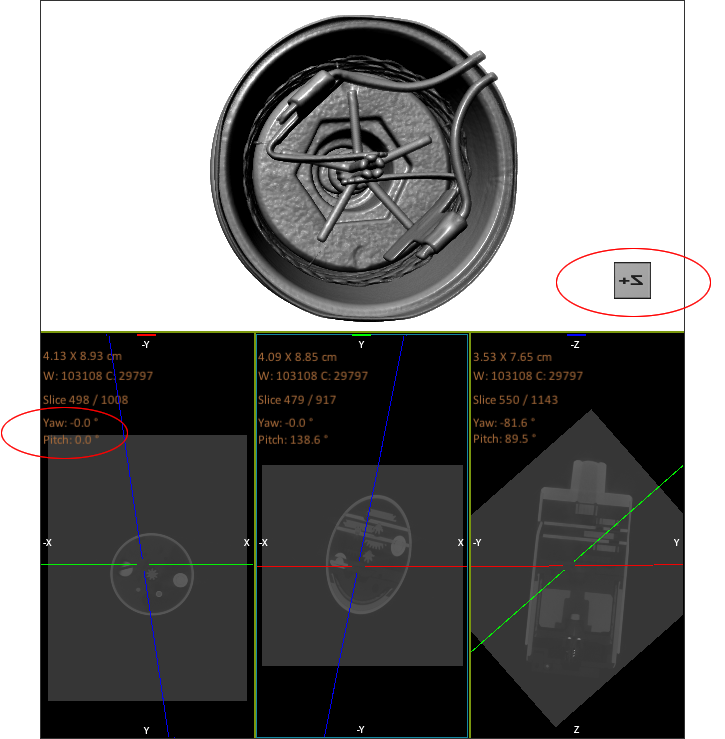
Align with Current View
Automatically rotates the selected volumetric dataset so that the selected axis is aligned to the Z-axis of the world coordinate system.
Align Centroid With
Lets you automatically align the centroid of the selected dataset with the centroid of another object. Applicable objects include volumetric image data, regions of interest, multi-ROIs, and meshes. Reference objects can be selected in Choose the object to align with dialog.
Apply Transformation From
To help maintain consistency when you work with multiple objects, you can apply the transformations, such as translations and rotations, that were applied to a reference object to the selected image data. You should note that only objects that were translated and/or rotated, will be available in the Choose an object dialog as the reference.
New Greylevel Multi-ROI
Creates a multi-ROI in which each value in the dataset is assigned a label. If there are 2,000 values in the dataset, then there will be 2,000 labels in the multi-ROI. Usually done after post-processing, such as creating a distance map, to create a sparse representation of the gray tones in a dataset. You should note that this option is not available for datasets in FLOAT.
In some cases, you may want to split non-connected labels that were created from the same data value (see Split Not Connected Labels).
Dijkstra Shortest Path Map
Creates a distance for a selected region of interest using Dijkstra's algorithm for finding the shortest paths between nodes.
Refer to en.wikipedia.org/wiki/Dijkstra%27s_algorithm for more information about Dijkstra's algorithm.
Fast Marching Speed Map
Creates a distance map for a selected region of interest using the numerical method created by James Sethian for solving boundary value problems of the Eikonal equation.
Refer to en.wikipedia.org/wiki/Fast_marching_method for more information about the fast marching method.
New Dataset from Marked Slices
Lets you extract a new dataset from marked image slices (see Extracting New Datasets from Marked Slices).
Dataset Registration
Lets you to register a selected dataset to a baseline by modifying its position and/or rotation (see Registering Datasets).
Create 4D Dataset
Lets you create a 4D, or time-enabled, dataset from multiple volumetric datasets (see Creating 4D Datasets).
Stitch 3D Datasets
Lets you combine, or merge, multiple volumetric datasets into a single 3D dataset (see Stitching 3D Datasets).
Slice Registration
Lets you to align the slices within a dataset to build a consistent image stack (see Aligning Image Stacks).
Add Gaussian Noise
Lets you add Gaussian noise to the selected dataset.
You can select the level of noise required in the Standard Deviation dialog.
Extract ROIs
Automatically creates a new region of interest for each intensity value in the selected dataset.
Normalize Histogram
Lets you normalize the histogram of a selected dataset to the histogram of another dataset.
Overwrite Dataset
Overwrite the values of a dataset with the intersecting values of the selected, or reference, dataset.
The reference dataset and the dataset to overwrite must be of the same data type — UBYTE, SHORT, UINT, or FLOAT. For best results, the datasets should also be within the same value range. If required, you can convert or normalize data within a selected range with the Dataset Tools.
How to Overwrite Dataset Values
- Right-click the reference dataset and then choose Overwrite Dataset in the pop-up menu.
- Choose the dataset you need to overwrite in the Choose a Dataset to Overwrite dialog.
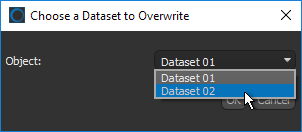
- Click OK.
Copy
Copies the selected dataset and adds it to the list at the top of the Data Properties and Settings panel.
Remove
Removes the selected dataset from the Data Properties and Settings panel. All views related to the dataset will also be removed from the workspace.
Create a Box From Current Box
Automatically creates a box that corresponds to the dimensions of the selected dataset.
Resample Geometry
Copies the intersected values of the selected dataset into the geometry (or shape) of another object to create a new dataset. Might be necessary if you need to extract statistics from an ROI or multi-ROI, such as the minimum, maximum, or mean values of corresponding image data (see Statistical Properties), or intend to compute other measures that require consistent shapes.
How to Resample the Geometry of a Dataset
- Right-click the dataset you want to resample and then choose Resample Geometry in the pop-up menu.
The Choose Name and Geometry dialog appears.
- Enter a new name for the sampled dataset in the Name field.
- Choose the object with the required geometry in the Geometry drop-down menu.

- Click OK to resample the geometry of the selected dataset.
The intersected values are copied into the new shape and the resulting object appears in the Data Properties and Settings panel.
Inpaint
Can be used to remove small defects within an image or to replace lost or corrupted parts of image data (see Inpainting).
Items Available for Multiple Selections
The following items are available whenever you select two or more datasets in the Data Properties and Settings panel.
Segment with Classifier
Lets you automatically segment image data with any of the classifiers that you created or downloaded for trainable segmentation (see Segmenting Image Data with Trained Classifiers).
Export as Multiple ORSObjects
Exports the selected items in the ORS Object file format (*.ORSObject extension) to a selected folder as multiple files (see Exporting Objects).
If the selected items share the same name, their file names will be appended with a sequential number.
Export as ORSObject
Exports the selected items to an ORS Object File (*.ORSObject extension) to a selected folder (see Exporting Objects).
Execute Macro
Provides a shortcut for selecting macros that can be executed for the number of items selected.
Align with Current View
Automatically rotates the selected volumetric datasets so that the selected axis is aligned to the Z-axis of the world coordinate system.
Create 4D Dataset
Lets you create a 4D, or time-enabled, dataset from multiple volumetric datasets (see Creating 4D Datasets).
Stitch 3D Datasets
(This is the Drop-down text)
Add Gaussian Noise
Lets you artificially add Gaussian noise to an image. Deliberately corrupting an image with noise may be useful in cases in which you need to test the resistance of an image processing operator to noise or to assess the performance of various noise filters.
Normalize Histogram
Lets you normalize the histogram of the selected datasets to the histogram of a reference dataset.
Create Moment Dataset
Lets you create the following moment datasets from the current selection:
Mean… The first raw moment, which is the mean value of the pixels in the selection.
Variance… The second central moment.
Skewness… The third order moment about the mean. Skewness is a measure of symmetry, or more precisely, the lack of symmetry. A distribution, or dataset, is symmetric if it looks the same to the left and right of the center point.
Kurtosis… The fourth order moment about the mean. Kurtosis is a measure of whether data is heavy-tailed or light-tailed relative to a normal distribution. That is, datasets with high kurtosis tend to have heavy tails, or outliers. Datasets with low kurtosis tend to have light tails, or lack of outliers.
Hyperskewness… The fifth central moment.
Hyperflatness… The sixth central moment.
Resample Geometries
Copies the intersected values of the selected multi-ROIs into the geometry (or shape) of another object to create new datasets. Might be necessary if you need to extract statistics from a multi-ROI, such as the minimum, maximum, or mean values of corresponding image data (see Statistical Properties), or intend to compute other measures that require consistent shapes.
- Choose the object with the required geometry in the Geometry drop-down menu.
- Click OK.
The intersected values are copied into the new shape and the resulting objects appear in the Data Properties and Settings panel.
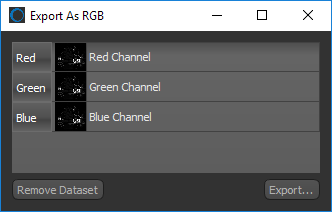
Export as RGB
Lets you export selected RGB channels in the BMP, JPEG, PNG, and TIFF file formats.
You should note that you can drag channels up and down to match them to a specific output in the Export as RGB dialog, shown below, as well as replace channels as required.